Guest blog by Michele Paige Holmes, author of Counting Stars and All the Stars in Heaven. Michele blogs at My Paige. I saw Michele’s post and thought you might find it very interesting. I did!
As promised, here is a little more information on the criteria I personally look for when judging for the romance category of the Whitney Awards. Be forwarned, this is likely to be a long post, as each of these subjects could be a blog—or three—by themselves. I’ll do my best to give concise examples of each. Feel free to leave a comment if you disagree or have another opinion. Feel free to take a nap if I’m boring you.
But romance, for me, is a passionate subject.
As I mentioned previously, there are no specific guidelines given to judges of the Whitney Awards. First, to answer Stephanie Black’s question about the process, what it comes down to is having a ranked list (from 1-20 in romance this year) of the books from best written to, well, the not best written. It would be more gentle, perhaps, to say favorite to least favorite, but the Whitney Awards are not about favorites—regarding authors, subject matter or anything else. Case in point being the general category last year. Jonathan Langford’s book, No Going Back, dealt with a subject matter—a teen boy’s struggle with same sex attraction—that I didn’t particularly want to delve into. As a mother of a teenage boy, this pretty much sounded like one of my worst nightmares. Based on that, one would think that there was no way this book was going to be my “favorite” or anything close. I began reading, and I wasn’t very far into the story before I found myself really caring about the main character and his plight. I’m happy to say I was one who voted it into finalist status. It was well-written and very deserving. And while I don’t count it as one of my favorite books—the subject matter just isn’t something I want to dwell on—it was definitely one of the best general fiction nominees last year.
I hope, in some small way, this reassures all whose books have been nominated. I believe the judges really do try their best to be fair, impartial, and accurate. Being a writer myself, I understand that to some extent we hold your heart in our hands. I want to treat it gently—but I also want it to get stronger!
One thing more about the process, and then I’ll get to the details. The judge’s ballot is different from the ballot that the academy receives. Judges are asked to compare every book to every other book in that category (as in, is book XYZ or book ABC more deserving of the Whitney Award?), so it is easiest to complete voting with a ranked list. Formulating that list is the difficult part. As I read, I don’t make any permanent decisions about where I will rank each book (though I have a pretty good idea with some). I do take notes about each nominee and record these on index cards. Then, as I progress with my reading, I am able to arrange those cards in the order I feel they belong.
Here is a small sample—the good, bad, and ugly—of some of the notes I’ve made while reading the romance nominees this year.
intense, realistic voice
Knew the end from the beginning, with no surprises along the way
Though the main characters were well developed, the secondary characters were flat and that made the storyline unbelievable.
Telling, telling, telling—so frustrating, because this plot could have been awesome.
Beautiful writing, right on for the time period.
Great romantic angst and emotional build up.
laugh out loud funny
This was a romance?
Couldn’t stand the guy . . . not buying that the protagonist could either.
Fantastic voice. Different and so fun.
So much head hopping, I am dizzy.
Okay, so some of those were pretty harsh. Blame it on my critique group. We’re kinda brutal, but it’s all in the name of improvement. And that’s the whole point of this post. I want every single romance nominee to be amazing. I want my decision, as a judge, to be nearly impossible because there are so many great choices. And more than that, I just want more good romance reads out there!
Here, once again in my opinion, are the things that make a wonderful, unforgettable romance.
A story that grabs my attention and pulls me in—
The first time I attended my critique group, I’d just finished reading what I was sure had to be a brilliant chapter, when a member of our group said to me, “I don’t know where your story begins, but it isn’t here. Go home, throw this away, and start over.” I remember swallowing a big lump of emotion and nodding like I understood what she meant. In reality, I had no clue, and it was quite a few months before the light bulb went on and I understood that my first chapter, while sweet and lovely and all that, was nothing that was ever going to capture a reader’s attention—much less a publisher’s. Readers these days are busy people. The only way I have time to read is when I choose to give up sleep. About once a week, I make that choice and begin a new book around 9 pm. If that book doesn’t grab me in the first chapter, forget it. I need my sleep.
So what is it that pulls me in? Voice (whatever the heck that is, right? Good Grief by Lolly Winston is an example that comes to mind), a unique situation, or an immediate problem. The place a story needs to start is in the middle of the action. But don’t tell me what’s going on (as too many nominees did this year) show me. Set me squarely in a setting that pulls me from my room into the main character’s world. Let me see her in motion, and quickly see the type of person she is. For some excellent examples—see the finalist list next week.
Characters I care about—
This one is critical. They all are, but if you don’t have this one . . . your romance isn’t going to get off the ground. In a female character (assuming here that most of your readers are female), readers want someone they can, on some level, identify and empathize with. I really didn’t think I would like The Hunger Games (why would a forty-year-old mom want to read about teens killing each other? We have enough of that at our house already . . .), but in that very first chapter, I began to identify with Katniss, her love for her sister and her desire to provide for her family. When she traded places with her sister and put her own life in danger, I was hooked.
That isn’t to say that readers have to identify with everything in a character. Nor do we want a character to be perfect. This happens more often than not in romance, and it is very irksome. Female protagonists who are beautiful, slender, excellent cooks, good tempered, patient, kind, etc. aren’t realistic. A character should be just that, someone with a unique set of qualities (and flaws) that make her human—like the rest of us. But a word of caution here, please don’t create flaws in your character just to fill this requirement. This also happens far too often in romance, and readers see right through it. Instead, think hard about your protagonist’s life, where she’s come from and what experiences have molded her into the person she is.
Unfortunately, when it comes to the leading men in romance novels, often readers see more flaws than good. Word of warning: If the guy is a complete jerk at the beginning of the book and does something pretty unforgivable, or acts in a way that is immature, egotistical, promiscuous etc. then your reader is going to have a difficult time liking him. He’ll have to change, and the reader will have to see that change (and the motivations behind it) in a believable, realistic way. If the guy is not likable or lovable, but the girl loves him anyway, the reader then loses respect for her too. So ask yourself, what is it about this guy that makes the main character love him? And does that tip the scales on any baggage he might be carrying?
A couple of things to watch for with male characters—It’s all right for them to cry—once in a while, if something really drastic and awful happens. But when a guy cries, gets misty-eyed etc, all throughout the story, it’s not believable or desirable. Yes, we want our men to have feelings. But we don’t want them to be like us!
One other thing that the guys in my critique group have called me on a time or two—men don’t over think/over analyze/over discuss stuff like women do. If you’re in your guy’s POV, make sure it is a guy’s POV.
A believable plot— (and I’m going to add here, an interesting plot, as well)
There are only so many romance plots out there, right? And they all keep getting recycled. To some extent this is true. And in some ways, I think the job of the romance writer is more difficult than that of those who write other genres. In a mystery or suspense novel, the reader keeps turning pages, trying to discover who did what, who is good, who is evil, what clues add up to solve the mystery etc. If it’s a good suspense, often times all the threads don’t tie up neatly until the last few pages. Readers are given thrills along the way and some real satisfaction for having stuck it out so long.
In a romance, boy meets girl, boy and girl fall in love, some difficult stuff happens, they overcome it, and they live happily ever after. As Jeff Savage would (and has) said, “bor-ing.” But by definition, a romance must end with the two main characters in a committed relationship, so really, the reader knows from the get go what the ending will be. Why even bother reading a romance? Because the ways to get from A-Z are infinite. Because reading (recreating, if you’re the writer) that wonderful, heady feeling of falling in love is so much fun!
What are a few ways to make that basic formula and those recycled plots believable and interesting?
-flip it around (using my own example here. In Counting Stars I based the plot loosely on a familiar rhyme—backwards. “the babies in the baby carriage, then comes marriage, last comes love”)
-Consider more than one love interest (Jacob and Edward, anyone?) One of the books I think should be a finalist did this extremely well, and for much of the book, I really didn’t know who the main character would end up with. What made this work is that both guys were viable choices. Sure, they weren’t perfect, but there were some pretty good things going for each of them, and she had feelings for both—ahh, angst. LOVE IT!
-Assemble a good supporting cast. This really is important. I remember reading somewhere (probably in the Romance Writer’s Report years ago) that every heroine needs a best friend to whom she can confide important feelings and events that move the plot forward. When a protagonist does not have this, then the reader is forced to rely on what is in the main character’s head (not always bad, esp. if the book is in first person) and any action we see. Along with this, well-developed secondary characters give the story depth and make it much more believable. If the people and world around your main characters fall flat, then the story will too.
A believable love story that builds in a natural, realistic way—
Years ago, Jeff Savage taught me about a common writing mistake called, “unearned emotion.” Basically, this is when a character is displaying emotion (in romance, it’s usually crying) before the reader has seen the cause of that emotion or when the character really has no cause to behave that way. Even more bothersome to me than unearned emotion, is unearned intimacy. Romance is about love, not lust. But when characters are throwing themselves at each other in chapter two, it makes the reader wonder. Fortunately, we don’t get much bodice ripping in the LDS market, but a passionate embrace and lengthy kiss that comes out of nowhere (as in, when the main characters have hardly spoken to each other for three chapters) is NOT believable. Worse than that, it cheats the reader of genuine, romantic tension and build up. Make us wait for that kiss, dang it. And then make it good.
Believable dialogue—this is the romance writer’s greatest tool. Please make it real. Silly, flirty, and redundant conversations aren’t how most people (or people we want to read about, anyway)speak to one another. Continuous fighting between characters makes a reader weary. Sure, they can start off on the wrong foot, but at some point fairly quickly in your story, that needs to change so the characters connect with each other.
Avoidance of head hopping/Point of View changes—Bless Angela Eschler for teaching me how important this is. When I turned in my first manuscript, it had several chapters with frequent POV changes. Angela (my most awesome editor at the time), said I had to fix them all. I pointed out that this is common in romance novels, and readers are smart and can easily follow POV changes. She pointed out that it was lazy writing. She was right. I was also right. Head hopping is sinfully common in the romance genre (where are all the editors, I say???), and yes, readers are generally smart enough to follow along. The problem is that it continuously pulls them out of the story. Our main job as writers is to pull the reader so thoroughly into our story that she forgets she is reading. This becomes impossible when the reader has to pay attention and is constantly jumping from one character’s thoughts to the other.
I think romance writers often feel the need to show both points of view. We feel the reader needs to see both sides, right now. They don’t. Josi Kilpack taught me that a scene should be placed in the POV of the character who has the most to lose. I’ve never gone wrong sticking with that advice. And it really is okay for the reader to wait until the next chapter to find out what the guy (or girl) is thinking.
An exercise I always do when I finish my first draft is to go back through the story and make a list, chapter by chapter, of whose point of view it is in. This helps me catch any head hopping I’ve done, and it also tells me if I’ve got the right balance in my story. Unless I’m writing in first person, I need to give a fair amount of time to the man in my story as well as the woman. A 2/3 (girl) to 1/3 (guy) to 1/2 and 1/2 ratio seems to work well.
A plot that moves forward instead of backward—Yes, you have to start your story in the action, but please don’t flashback to everything before that! Flashbacks, like head hopping, are a writing sin. Especially when they are long, complicated, and frequent. There are better ways to weave important back story and information into your plot (remember that best friend?). Like head hopping, the big problem with flashbacks is that it pulls the reader from your story. Do that too many times, and she drops it permanently.
Instead, move your plot forward. Every single scene must do that. This is one I struggle with. I’m happy to let my characters linger longer. Reader’s aren’t. So while a chapter may show a relationship building, it also needs to have something about it that is propelling your plot toward the final crisis and conclusion.
An overall package the suspends disbelief and evokes emotion—
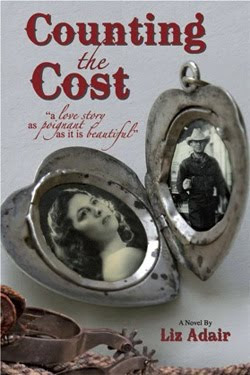
If you meet all of the above criteria, there’s a good chance your story will suspend disbelief, but creating a story that evokes emotion can be even more difficult. At the Whitney Awards Banquet last year, when it was announced that Liz Adair’s Counting the Cost won the award for best romance, I leaned over to my husband and whispered knowingly, “her book made people cry.” I think books that make people feel succeed on a whole different level than books that simply entertain. That isn’t to say you have to write a tear jerker romance to win a Whitney in this category. But if you’re fortunate enough to have the voice, characters, plot, and romantic angst come together in a way that makes people laugh or cry, so much the better—for me as a reader! This is where writing really becomes an art form, and a practice in patience. Rewriting, editing, cutting dialogue and scenes, adding others in their place, really taking the time to play with words until they fit together magically is what being a writer is all about. Honoring those writers who have done that, is what the Whitney Awards are all about.
A sincere congratulations to each and every nominee this year. You wrote and published a book! What an amazing accomplishment. If you are a finalist, thank you for writing an outstanding book, for entertaining, inspiring, and moving the rest of us. As I said in my previous post, may we all continue to strive for excellence.